Building a More Useful Hebrew Transliteration Scheme
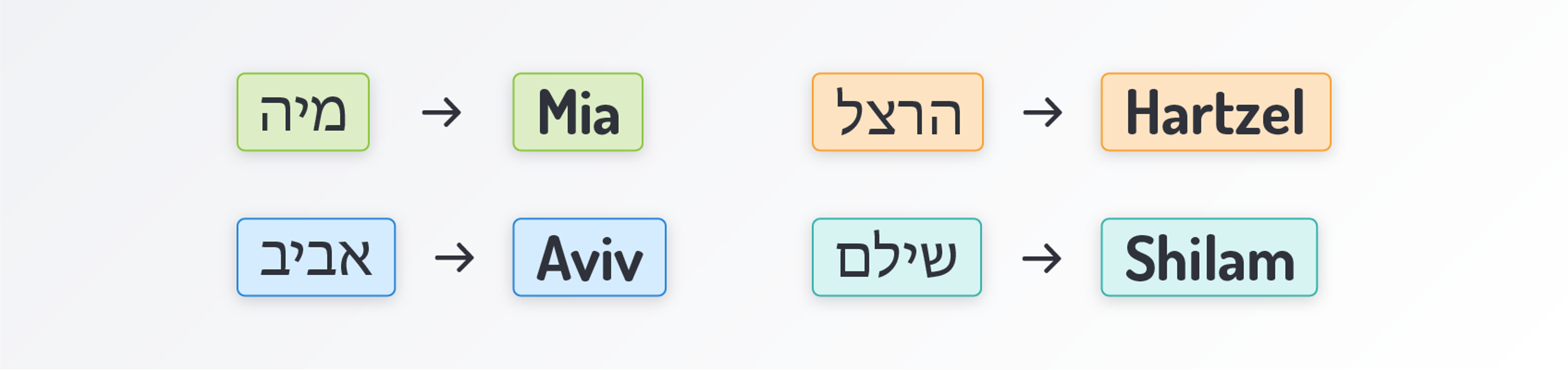
When the Rosette® Name Translator team set out to build a Hebrew-to-Latin character translator, one of the first considerations was: Which Hebrew transliteration standard should we use? As the joke goes, “Standards are great because there are so many to choose from.”
The existing Hebrew transliteration standards, ISO 259-2:1994 and UNGEGN (United Nations Group of Experts on Geographical Names) — which Rosette accesses via UNGEGN’s implementation by the ICU open source library — were created for scholars for whom unambiguous scientific transliterations were the top priority. ISO 259-2 was created to handle the processing of bibliographic information. The UNGEGN uses transliteration standards in service of its mission to compile and disseminate global statistical information.
On the other hand, most Rosette Name Translator users are looking for Hebrew transliterations that are more compatible with those that show up in a database, or would be used in searches, and are pronounceable. To fulfill these specific requirements, Babel Street created the “folk” transliteration scheme.
The Basis Tech scheme is more user-friendly, as it prioritizes pronounceable transliterations and doesn’t contain diacritic marks. It should be noted, however, that this scheme has ambiguity, so it is not possible to roundtrip — i.e., convert from Hebrew to Latin and back to Hebrew, with fidelity. In Hebrew, some letters are pronounced the same, so the Basis Tech scheme will map to the same Latin letter in the transliteration. For example, the folk transliterator maps the Hebrew letters “ט” and “ת” to “t,” a many-to-one mapping.
Two difficult Hebrew transliteration cases are worth noting.
1. Difficulties vocalizing Hebrew
First, Hebrew is regularly written without nikud, which are marks that indicate how to pronounce words or may stand for vowels. Native speakers can read Hebrew without nikud because of the word’s context, but Romanized Hebrew is always written with vowels, so the transliteration involves some guessing at the correct vowels. Even if the guessed vowel may occasionally be incorrect, Basis Tech should map all the consonants from Hebrew into Latin. There is, however, the case where if the wrong vowel is guessed, an adjacent consonant may also be incorrectly transliterated.
Suppose the correct spelling of a Hebrew word included a diacritic hirik for the sound “i,” followed by the yod, which is transliterated as “y.” In Hebrew, hirik+yod appears as אִי .
Scientific transliteration standards map this combination of hirik+yod (אִי) to “iy” (i.e., following the principle of mapping one character to one character), but the Basis Tech transliteration will avoid the “iy” mapping and just use “i.”
Hebrew Names with Hirik+Yod
Hebrew
(without nikud)
Hebrew
(with nikud)
Folk Transliteration
ICU Transliteration
(UNGEGN standard)
ISO 259-2:1994 Transliteration
סיגל
סִיגַל
With nikud: SigalNo nikud: Sigel
With nikud: SiygalNo nikud: Siygé̇l
With nikud: SiygalNo nikud: Siygel
שילם
שִילֶם
With nikud: ShilemNo nikud: Shilam
With nikud: ŞiylemNo nikud: Şiylam
With nikud: S̀iylemNo nikud: S̀iylam
אביב
אַבִיב
With nikud: AvivNo nikud: Aviv
With nikud: ʼábiybNo nikud: ʼábiyb
With nikud: ʾabiybNo nikud: ʾabiyb
On the other hand, if the correct vowel was patah ( ַ ) with yod, it should be transliterated to Latin “ay,” but Rosette might make a mistake in some cases and output Latin “iy” instead. In Hebrew, patah+yod appears as אַי .
In other cases, the folk transliterator will just output Latin “i,” which is wrong because it deletes the consonant due to guessing the wrong vowel.
Hebrew Names with Patah+Yod
Hebrew
(without nikud)
Hebrew
(with nikud)
Folk Transliteration
ICU Transliteration
(UNGEGN standard)
ISO 259-2:1994 Transliteration
מיה
מַיָה
With nikud: MayaNo nikud: Mia
With nikud: MayáhNo nikud: Miyáh
With nikud: MayahNo nikud: Miyah
איילה
אַיָילַה
With nikud: AyailaNo nikud: Ila
With nikud: ʼayáylahNo nikud: ʼiyláh
With nikud: ʾayaylahNo nikud: ʾiylah
2. The Ambiguity of the Shva
The vowel character shva (two stacked dots under a character) has two possible pronunciations: as a vowel or silent. But software cannot distinguish between when the shva is voiced or silent with 100% certainty. When pronounced as a vowel, the shva maps to “e,” but when silent, it should not map to any character. The ICU/UNGEGN always transliterates shva as “ĕ.” The ISO 259-2 standard always deletes it. Babel Street transliterates the shva as “e” or deletes it, depending on the guessed pronunciation.
The Rosette algorithm makes a best guess about the shva’s pronunciation based on the allowed phonetic clusters in Hebrew. Additional exceptions to the rules are wired in to allow for cases when a borrowed foreign word in Hebrew may violate the phonetic cluster rules.
Hebrew Names With Silent Shva
Hebrew
(without nikud)
Hebrew
(with nikud)
Folk Transliteration
ICU Transliteration
(UNGEGN standard)
ISO 259-2:1994 Transliteration
הרצל
הֵרְצֶל
With nikud:
Hertzel
No nikud:
Hartzel
With nikud:
Hérĕẕel
No nikud:
Harĕẕĕl
With nikud:
Herṣel
No nikud:
Harṣl
פנינה
פְנִינָה
With nikud:
Pnina
No nikud:
Pnina
With nikud:
Pĕniynáh
No nikud:
Pĕniynáh
With nikud:
Pniynah
No nikud:
Pniynah
בלום
בְּלוּם
With nikud:
Blum
No nikud:
Blum
With nikud:
Bĕ̇lẇm
No nikud:
Bĕlẇm
With nikud:
Ḃlẇm
No nikud:
Blẇm
Hebrew Names With Voiced Shva
Hebrew
(without nikud)
Hebrew
(with nikud)
Folk Transliteration
ICU Transliteration
(UNGEGN)
ISO 259-2:1994 Transliteration
רננה
רְנַנָה
With nikud:
Renana
No nikud:
Renana
With nikud:
Rĕnanáh
No nikud:
Rĕnánáh
With nikud:
Rnanah
No nikud:
Rnanah
נהר
נְהַר
With nikud:
Nehar
No nikud:
Nahar
With nikud:
Nĕhar
No nikud:
Náhar
With nikud:
Nhar
No nikud:
Nahar
לביא
לְבִיא
With nikud:
Levi
No nikud:
Lavi
With nikud:
Lĕbiyʼ
No nikud:
Lábiyʼ
With nikud:
Lbiyʾ
No nikud:
Labiyʾ
In brief, the Basis Tech folk transliteration scheme attempts to balance fidelity with how words are pronounced in Hebrew, while producing name translations that will resemble what people type into search and database systems. Try out our Hebrew name translation by signing up for a Rosette Cloud account.
Published